Sunday, May 31, 2009

Super Ultra Light / Super Ultra Cheap PT 1 - Bivy

Making the Bivy: !!!See Notice at the bottom of this post!!!.

The first picture shows the GG Ground Cloth laying on my pattern. The size of the Ground Cloth is almost the same size as my pattern. I am leaving a 1" seam allowance. This will allow me to turn it under to reinforce the seam.

1. GG Ground Cloth on the Pattern.


2. The GG Ground Cloth is cut and weighs 41 grams or 1.44 ounces. Cost for one of 2 GG Ground Cloths = $4.00 plus shipping.


3. The Propore on the Pattern ready to mark.


4. The Propore cut and ready to sew. The weight of the Propore Bivy Top is 4.7 ounces. Cost as a new Frogg Toggs Poncho = $11.50 plus shipping.


5. Ready to start sewing.


Estimated cost for the materials only for the completed Bivy = $17.00 (+/-) a bit.
Estimated weight of the completed Bivy = 6 ounces (+/-) a bit

Sewing to follow.

NOTICE!!!!!!!!!

I had a lot of problems finding a way to sew the Polycryo material.

I would suggest anyone that wants to sew with this material that you do many tests and stress the seams a bit till you are happy with the sewing method.


6.


7.


8.


The Bivy weighs 6.1 ounces. I will make a small hood out of Propore and attach the hood sometime over the next day or so.

This Waterproof / Breathable Bivy can be made for about $17.00 if you do your own sewing.

Super Ultra Light / Super Ultra Cheap

A Really Light and a Really Cheap Gear List.

Can we find enough really cheap or almost free (as in recycled) material to build a decent set of Super Ultra Light (SUL) gear?

The complete gear list has to be under the 5 pound weight as defined by BackpackingLight.com as SUL and survive a continuous hike of at least a 165 miles on a trail system such as the Appalachian Trail. The material used for this gear needs to be readily available and not just enough to make one or two items.

I think the total weight / cost will be a good surprise to many.

1 - Backpack:

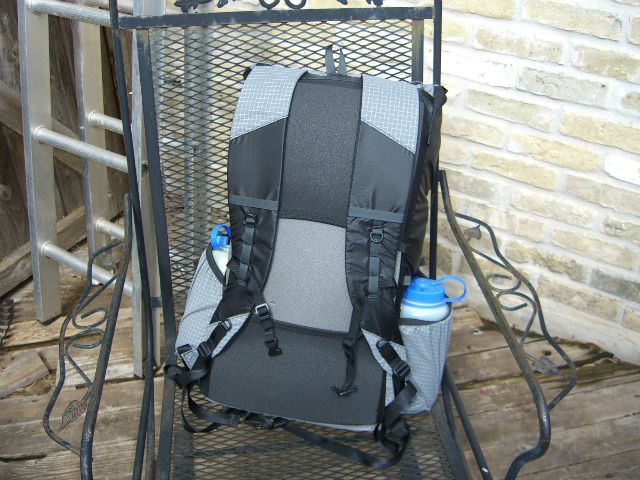
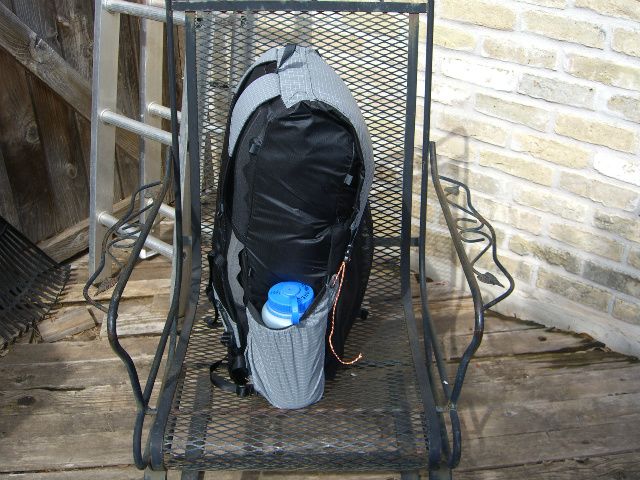
I have been playing with one type of material that turns out to be good for packs. I have even used this material for shoulder straps and hip belts.

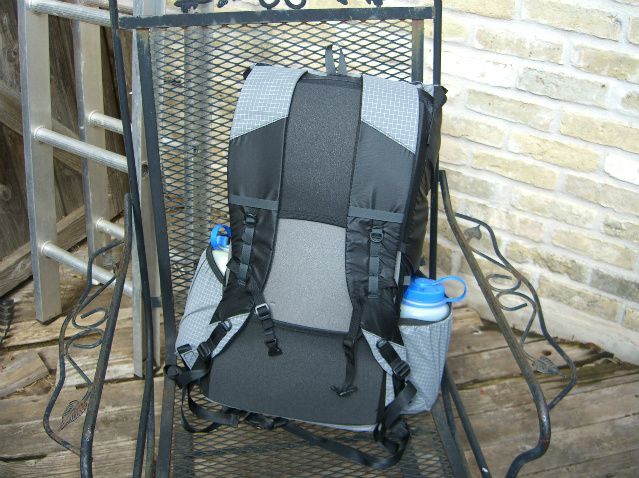
You can see the first pack bag I made out of this material in this picture.


The material weighs 3.4 ounces a square yard but the total weigh for a decent size pack should be well under one pound. The material is very strong and easy to sew.

The real $$ cost of this pack ( the material is from something meant to be thrown away) might be $5.00.

With this as the first item on my Really Cheap Gear List, I am off to see what I can come up with next.

2 - Bivy:

=================================================
NOTE 1.

The Polycryo material is not working. I have tried to sew it several different ways and that did not work. I then tried a tape that works on Cuben Fiber and that also did not work. I have stopped working on the Bivy. I have a couple of ideas and will try them. If anything works I will post my results.
=================================================
NOTE 2.

I spent time trying different ways to sew the Polycryo material and think I have a way for it to work. I would warn anyone that wants to try sewing Polycryo to test several different ways till you find a way to make it work.
=================================================


Bottom Material:

Gossamer Gear sells a "Polycryo Ground Cloth.

I bought one of their (2) packs several years ago. At the time I thought this stuff might be good for other things but since I was using a lot of Cuben Fiber I never made anything with it. When I first got mine I weighed it to see what the square yard weight was. It is 0.568 ounces per sq yard.

The ground cloths cost (2) for $8.00. Now that I am looking for cheaper alternative materials I am re-looking at what I might be able to make with this material.

I have made several Bivys using Cuben Fiber as the bottom and Pertex Quantum as the top. I will try a Bivy using one of these Polycryo Ground Cloths for the Bivy Bottom.

From GG about the Polycryo Ground Cloths:

"The Polycryo ground sheet is constructed from industrial grade cross-linked polyolefin. This material is extremely tough for it's weight, with amazing puncture resistance. It has a tensile strength of 15,400 p.s.i. (1,083 kg./sq. cm.) per ASTM D-883. It is waterproof, but very slightly breathable (1.09 gms of water vapor/100 sq.in./24 hours). At 0.55 oz./sq.yd. (16 g.), it's HALF THE WEIGHT of our Spinnsheetâ„¢ ground cloths. You will have to replace this more often than tougher alternatives, but it's very economical. These single ground cloths are shipped as a 2-pack so you have an extra. Our medium size is 40" (102 cm.) wide.'


Ground Cloth Link

Top Material:

Frogg Toggs make a poncho out of a very nice material that is said to be 100% waterproof and breathable. It would seem that this material would make a good top material for the Bivy. I need to find out the size of this item but just in looking at it I am sure it is big enough.


Frogg Toggs Poncho

I believe that Frogg Toggs is made from something like 3M Propore. I have a sample of the 3M Propore and it weighs 2.37 ounces a squard yard.

A Bivy made from the GG ground Cloth and the material from a Frogg Toggs Poncho should weigh about 6 ounces.

Cost: I have found the Frogg Toggs Poncho list on two different web sites. It is selling for $11.50 at one place and seems to be on close out at $8.95 on another web site. I will call both on Monday and confirm prices. Using what seems to be the MSRP of $11.50 for the Poncho and $4.00 for one GG Ground Cloth, the total Bivy cost would be a bit under $16 plus shipping, tax etc.

3 - Shelter - Tarp

My first thought is to make a tarp out of 3 GG Ground Cloths sewn, glued or taped together.

The Tarp would be about 10" by 12' and the tarp material weight would a little less than 2 ounces. Add in some weight for the tie out line ( 1.42 oz) 6 stakes made out of - you pick it ( 1.23 oz) and a few secret things and you have a big tarp that weighs under 5 ounces.


If you have an idea you would like to share leave a me comment.

More to follow.

Tuesday, May 19, 2009

Pertex Quantum / Cuben Fiber Bivy - New Black Bivy

Pertex Quantum / Cuben Fiber Bivy - New Black Bivy

I needed to make another Pertex Quantum / Cuben Fiber Bivy. I discovered that when you go several years between making the same thing you can forget a lot of how you did it.

I made my first Pertex Quantum / Cuben Fiber Bivy back in Sept. 2006. When I went to look for my old pattern I discovered I had recycled it into something else. OK, just make a new one. After cutting the material I realized that I could not remember how I had made the hood and how I had closed off the foot end. It took three tries practicing on some of my $1 a yard WalMart stuff to figured it out.

The new Bivy has a few extra features on it such as loops at each corner and a loop in the center of the hood.

The Black Pertex Quantum and Cuben Fiber Bivy weighs 3.128 ounces. The loops count for 0.176 of an ounce and put the Bivy just over the 3 ounce mark.

The first Bivy I make weighs 2.82 ounces but that is without the extra 5 loops like I put on the Black Bivy.

1. Cut the Pertex Quantum material. I use a hot knife to cut the material.


2. Trying to remember how I made the hood.


3. Getting ready to cut the Cuben fiber. I am using some of the 0.33 ounce per square yard Cuben Fiber. I use a #11 blade in an X-acto knife to cut my Cuben Fiber.


4. Everything cut and ready to start sewing. I sew all my Cuben Fiber.


5. Black Bivy finished. You can see three of the loops I put on this Bivy. The other two loops are at the foot end. Total weight is 3.128 ounces or 88.7 grams.


6. My two Pertex Quantum and Cuben Bivys.

Friday, February 27, 2009

10-20 Degree Cuben/XP Sleeping Bag - 15.6 ounces - Done

As a result of several good medical checkups this month I have a three month window between now and my next set of follow-up exams the first of June. For the first time in several years I am going to have some time to go for one or two hikes of 2 or 3 weeks duration maybe more but I don't want to be overly optimistic at this time. My first hike goal will be to follow the Appalachian Trail (AT) north from Springer Mtn to Fontana Dam or about 164. This hike will take as long as it takes and will let me know just what kind of shape I am in and how my gear works. Then according to a lot of factors such as another group of good checkups in June I will try for longer hikes and may see how much of the AT I can hike this year.

I want to try and go sooner rather than later. Since it is still winter along the Southern portion of the Appalachian Trail I have decided to make a warmer / lighter Cuben Fiber Sleeping Bag for the hike.

When Cuben announced that color was available I ordered some Blue in the 0.33 ounce per sq yard product. I was disappointed in the lack of color and it sat in my closet. I will use some of the 0.33 ounce Blue Cuben I have for a new sleeping bag.

For insulation I will use 5 ounce per sq yard Climashield XP Insulation. When I bought the 5 ounce XP I weighed the whole piece (3 yards) and the average weight was around 6.5 ounces per sq yard. I will weigh the amount I use and then calculate the weight to give me a more accurate CLO valve.

The Sleeping Bag will be a "slide in" style and have a non-insulated Cuben bottom to save weight. I have made several Sleeping Bags with this design and have made a few modifications to my basic Sleeping Bag Pattern for this bag.

Current Material Weight:

Cuben Fiber at 0.33 ounces per sq yard - required 2.28 sq yards for the outer shell and the same for the inter shell. Cuben Fiber non-insulated bottom - 0.4 09 sq yards.
Total weight of Cuben Fiber (est.) 1.99 ounces.

I have cut and weighed the XP Insulation. Taking several samples from the 3 yards the average weight comes out to 6.06 ounces per sq yard - required 2.28 sq yards. Actual weight of cut to shape XP is 13.82 ounces. Clo value - 6.06 x 0.82 is equal to 4.969 or rounded up to a Clo of 5.

Total material weight at this point is 15.81 ounces. The weight at this point makes me think I can have a very warm Cuben Sleeping Bag at less than 16 ounces or one pound. With a Clo of 5, I will let you all decide for yourself what temperature that will be good for. I have my own idea and I expect this bag will be fine for my hike. Being old but not being stupid I will have something extra in case the weather gets really cold.

Source of Materials:

I get asked a lot where I get the material I use. I buy most of it from one of three places:

Quest Outfitters - Cuben Fiber by the yard, other material and fittings.
Thru-Hiker - Climashield Insulation, other material and fittings.
Outdoor Wilderness Fabrics - Climashield Insulation, other material and fittings.

I also buy Cuben Fiber direct from Cuben Corp but they require a purchase of 9 yards or more.

1.


2.


3.


4. Weight of XP is 13.82 ounces.


================

2 March 2009

I was a little busy over the weekend and didn't get anything done on my new Sleeping Bag. This evening I cut my first of two pieces of Cuben for the shell. Each piece weighs 23.7 grams or 0.84 of an ounce. If the Blue Cuben is 0.33 ounce per sq yard this would be 2.55 sq yards for each piece and up from my estimate of 2.28 sq yards that I used as a planning figure. I have both pieces of Cuben cut and ready to sew. I will cut the Cuben for the non-insulated bottom part after I sew the Cuben and XP together.

The extra material weight for both the Cuben and XP is from making the foot box area a little larger than the original pattern. This will give me an insulated foot box about 20 inches deep. If this Sleeping Bag was being made for warmer temperatures then I expect, I would not have added the insulated foot box.

5.


6.


7.


====

Moving right along. Getting ready to sew the Cuben for the bottom.

The numbers still look like the new Sleeping Bag will be under 16 ounces.

8.


9.


10.


11. Foot Box - Inside out


4 March 2009

The Cuben Fiber / Climashield XP - Sleeping Bag is finished except for the draw cord at the opening. The opening is 33" across and the foot box width is 16". I will finish the draw cord for the opening later today.

12.


The current weight is 15.45 ounces.

I believe this is a lot of Sleeping Bag and a really good Clo rating (5) for less than 16 ounces or One Pound. The total weight of the XP Insulation is 13.7 ounces. The weight of the Cuben Fiber Shell material is 1.75 ounces.

I got into the Bag and got warm really fast. I fit the Bag fine but don't have much extra space. This is how I planned the size, big enough but no wasted space. I do have room in the foot box area for my shoes so I don't have to worry about them freezing over night if it is that cold.

==

My new Blue Cuben Fiber / Climashield XP Sleeping Bag is finished.

Total weight is 15.55 ounces.

13.


14.


==

I have been in and out of the new Sleeping Bag a lot over the last few days and have even tried it out inside my 4 ounce Bivy, it is way to warm to stay in it for more than about 10 minutes. We don't get much cold weather here in San Antonio, Texas and It is going to go over 80 degrees this afternoon. Even over night I am sure I would get to hot to stay in it very long.

I don't want someone to find me in the morning, drown. That is a joke.

Date for my hike still not for sure. I got a very interesting item in the mail yesterday. I have been working on something for it today. I will post a few pictures of where I am with that later today.


I will see if I can get a picture of me in the bag. My camera has a timer but I think it is only a 10 second delay. I don't know if I can get in the bag that quick. I did a few practice runs and then took these pictures. The really funny ones didn't make the cut. This is the best I could do using my timer:

1. Slow.


2. Better by a little.


3. Better.


4. Better.


5. About the best it is going to get in 10 seconds.


The Sleeping Bag will come up to my nose when I have time to get in it slowly. If I lay on my side I can hid my head inside it.


==

By using this type of insulation it only needs to be sewn along the edges. If the item being made was really wide then I might have to stabilize the insulation. The Sleeping Bag did not require that so working with this type of insulation makes the work go sort of quick.

I have used a vapor barrier (VB) liner or VB clothes inside my cold weather Sleeping Bags for years. When I started looking for ways to really reduce the weight of my gear I made a lot of things out of Cuben Fiber. It was only a matter of time before I made my first Cuben Sleeping Bag. I didn't like the insulation I used but the Cuben worked fine. I save a lot of weight on shell material and now could leave the VB liner at home and the VB clothes were now an option.

The way the Cuben Sleeping Bag is made no body moisture can get to the insulation. The Cuben Fiber is completely waterproof. On the first Cuben Bag I built in a small vent system to help squeeze out the air or let air into the insulation. I improved upon that idea with this bag so if it is ever necessary to air out or dry out the insulation I can do that very easy.

Monday, January 12, 2009

"New" SUL External Frame / 1-1-2009 - Part 2

Next group of pictures - 12 Jan 2009

I have continued working on my new External Frame and it is ready for the Hip Belt, Shoulder Straps and Pack Bag.

The finished Frame weight is 12.5 ounces. With the 2.5 ounce Cuben Bag the current total weight is 15 ounces.

9.


10.


11.


12.


13.


14.


15.


16.


17.


18.


==

New External Frame With a Cuben Pack Bag.

The Cuben Pack Bag weighs 2.5 ounces . This frame / bag combination is just a test so I have a bag to put stuff in when I start carrying the frame to see how it works.

19.


20.


21.


==

14 Jan 2009

The picture with the pack bag is something I made to test a new material that I have recently discovered. It a woven material that is strong, almost light - 3.4 ounces per sq yard, very strong and almost free. It cuts and sews on the easy side. It is not some form of tyveck.

I think it might be strong enough to work as a material for a cheap bushwacking pack. I am going to made several packs in different sizes and try and get them tested under some harsh conditions.

1.


2.


3.


==

My goal is still a framed pack that will push away from my back. I will be trying to add that feature back in over time with the follow on versions. Some of that feature maybe in the way I finish my hip belt. One idea I have will require some of my Primitive blacksmithing skills. It will involve shaping some aluminum.

In building this frame I wanted to work out my Aluminum Tube Bending technique with this frame.

I also need to try and get this frame design lighter if I can before I add any additional weight to open up the window across my back.

Sunday, January 04, 2009

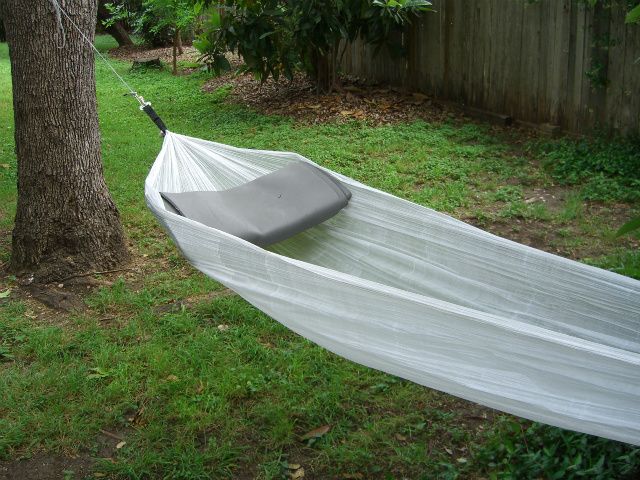
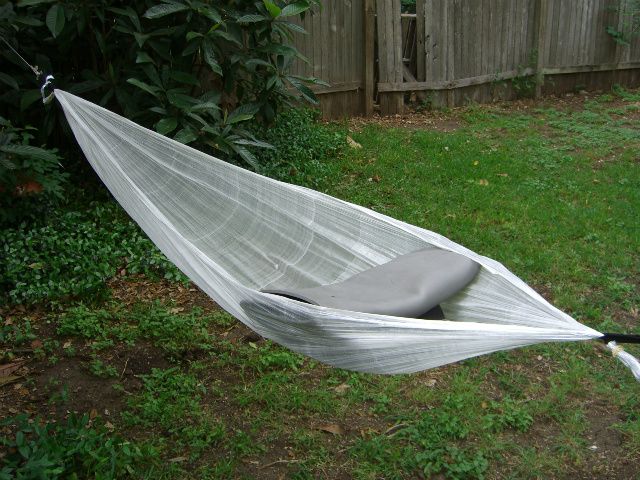
Winterizing My Cuben Fiber Hammock.

I am working on a way to extend the use of my Cuben Fiber Hammock down to a low temperature such as 20 or so F.

I have always used a sleeping pad or my Stephensons Warmlight Down Air Mattress (DAM) inside my Hammock when I need more insulation to keep my backside warm. When I made my Cuben Fiber Hammock I had less room inside the Cuben Hammock then I did in my Silk Hammock.

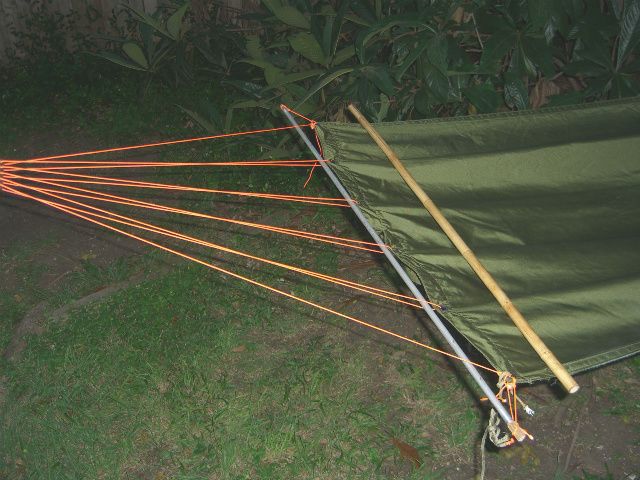
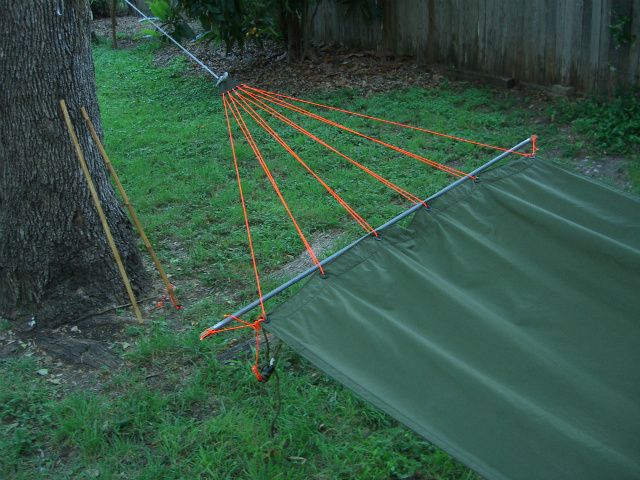
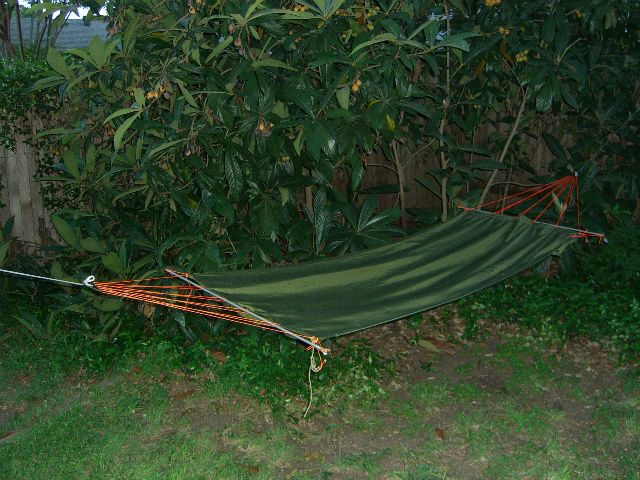
Paul, I friend of mine and Hammock Hanger had talked a lot about double bottom Hammocks. I didn't want to use another large piece of my Cuben Fiber just for a double bottom. This afternoon I had an idea, why not tie my Cuben Poncho/ Tarp under my Hammock. I have to make another larger Tarp so I could multi-use the Poncho / Tarp when necessary.

The following pictures tell the rest. The temperature while I was doing this was 38 degrees F with a nice wind blowing. I have to say I am pleased so far with how this has turned out. To test the setup I got into the Hammock. My weight presses me into the Down Air Mattress. The longer a was in the Hammock the warmer my back got. The Poncho/Tarp edges fold over some and encase the Down Air Mattress holding it in place.

How much does all this weigh:

Cuben Hammock Hanging - 6.65 ounces
Double Bottom - Cuben Poncho / Tarp - 2.8 ounces.
Warmlight Down Air Mattress - 24.53 ounces.
Inflate Bag - 2.8 ounces.

Total weight: 36.78 ounces

I am not real happy about the weight of the DAM but I have used it for several years and trust it down to near 0 degrees on the ground.

I will be working on what I use for top insulation over the next few days. I may be able to make back some of the weight I gave up for the DAM.


1.

2.

3.

4.

5.

Saturday, January 03, 2009

Patagonia #1 Merino Wool Hoody - Coming Soon.

Patagonia #1 Merino Wool Hoody - Coming Soon.

Patagonia has added a Merino #1 Wool T-shirt to their line of Merino Wool products. I ordered two, one to wear and one to use the material for a Hood. I will sew the hood on the other #1 Wool shirt and turn it into a Hoody.

I received the new Patagonia #1 Merino Wool T-Shirts today.


One in size large - weight is 3.5 ounces.
Second (donor shirt) in size extra large - weight is 3.8 ounces.

The color is sort of a southwestern rust/red with brown sleeves.

I will be wearing the size large awhile as I finish a few projects I am working on. Then I will cut up the XL for Hood material and sew the Hood on the size large.

I did this with a Patagonia Merino #2 Wool shirt and it turned out great.

Thursday, January 01, 2009

"New" SUL External Frame / 1-1-2009

SUL External Frame / 1-1-2009

I am making another SUL External Pack Frame. My goal is a frame similar to the modified Harrier Frame I have been working on but that weighs closer to one pound or less. The old frame was made to carry 40 to 60 pounds but the new frame should never have to carry more than 20 to 25 pounds.

I was talking to a friend who has been bending aluminum tubing for something he is making. I have never been successful at bending aluminum tubing. We talked about how he was doing it and I decide to give it a try.

I bought some 3/8" 6061-T6 aluminum tubing and have bent my first two tubes. I am happy so far with how they turned out. The bending process is a bit slow as you need to try and only bend a little at a time. The jig I made only helped get me started. The rest of the bending was more or less bent "free hand". I may have spent about 45 minutes on the two tubes. The second one went faster as my technique improved. The tubing I am using weighs about 1.4 grams per inch. The total weigh of the tubes that I bent weigh 32.7 grams or 1.15 ounces each. The bent tubes are 24.5 inches long. The actual length might change a bit.
1.


2.


3.


4.


I have made one more piece and this should be all the aluminum tubing I have to bend. This piece is more or less a half circle and will be used near the hip belt area. It weighs about 18 grams or 0.63 of an ounce and was all bent "free hand". It was much harder then the other two pieces to bend.


This first part has gone much faster than It thought it would. Now I need to take a bit of time and plan out the rest of the frame.

These are the two frame sections of the of the modified Harrier Frame. I am using the basic design of the modified Harrier Frame for the new frame but trying to reduce the weigh.

The top part weighs 469.2 grams or 16.5 ounces.

6.


7.


The bottom part weighs 440 grams or 15.52 ounces.

8.